Friday, December 31, 2010

Susan Bright


June 10,1945-December 29,2010

W
hen I went by the Armadillo a couple of days before Christmas, JC told me that Susan was at home sick. We had hugged on the opening day, but I had missed her during the week. Jay told me she was thinking of going to the Hospital. Since my partner is a physician, I gave him her cell phone number.

By Christmas Day, we learned that Susan was in St Davids.

"What's happening?" I asked Jay.

On Sunday, Susan was still talking about her condition, but under pretty heavy sedation. She told Jay that she felt like aliens had invaded her body. And indeed they had. Monday, the doctors put some stents in her kidneys hoping to reawaken them. By now she was becoming delirious. On Tuesday, her strong will and human force asserted itself. That evening, she was moved from IMC to a larger room on the fourth floor.

We brought in a small radio and we put in on KUT. Bill Bunch came by and he told her that he was missing her at the Springs. By Wednesday morning, Susan's walk on this earth was complete.

The daughter of William Bright, an oil executive, and Ann Safford, Susan Safford Bright was born in Pennsylvania on June 10th, 1945, just a few weeks after the fall of Nazi Germany, and two months before Hiroshima. She was raised on the left coast though. She was educated better than most of us, going both to Yale and to Stanford.

The first time I saw her was not in person but on video. Her husband to be, John Andrews (JC, Jay) was working on a video documentary of Austin Poets with Jim Norman, and they had come out to Space City Video to edit the tape.

I watched JC as he edited Susan's strong delivery. She was clearly a bird of a different feather. (She would hate me for saying that)

For the next 35 years, we raised our children , talked politics, and published together. Her publishing house, Plainview Press, published three of my books and more than 350 other works. Together, Susan and I managed to make Earthfamilyalpha the huge wealth of opinion, philosophy, poetry, and art that it is ... Over 1300 posts in four and a half years.

We would love to get a link from Truth Out or Crooks and Liars and watch the hits come in. We marveled how we could post something and then see readers from the other side of the globe reading our words an hour later. In the perfection of things, the Play in the Light post that I posted with word of her grave condition was picked up by Finn at Crooks and Liars. Her grave condition soon became national.

To say that Susan was a force would be a dent in her poetic nature....she was force.

Yet this piece from KXAN, like all the rest of us, can't resist saying it:

"Bright was a poet, publisher, activist, educator, mother, grandmother, friend and feminist. Since the 1970s, Bright was a "force of nature" among Austin's writers and activists. She authored 17 books of poetry; three won Austin Book Awards. Tirades and Evidence of Grace won the Violet Crown Award.

In 1990, Bright was selected as Woman of the Year by the Austin Women's Political caucus. For more than 30 years she was the editor and driving force behind the small, fiercely independent Plain View Press.

In her book Breathing Under Water and in many other works, Bright revealed herself to be the oracle of Barton Springs. At critical turning points in the struggle to save Barton Springs, Bright recited her work as testimony at public hearings before the Austin City Council.

In 2009 she recruited children and families to spring to the defense of Barton Springs' heritage trees. Her poem from that time, "Legend," concludes:

It is said the thirst of Earth’s
great trees calls water
from depths which are invisible
causing springs to flow.

Bright named one of the trees marked for removal, the one closest to the Philosopher's Rock statue at the front gate, the "Poet's Tree."

Michael Barnes writes in the Statesman:

"A good deal of her energy was devoted to the battle to protect Barton Springs, where she swam.

"Susan was the oracle of Barton Springs," said environmental activist Bill Bunch, executive director of the Save Our Springs Alliance. "She knew the springs like no one else. Her poetry will guide community efforts to save the springs for decades to come."

Since the 1970s, Bright participated in activist causes for women, peace and the environment. She helped organize festivals, workshops and conferences, including the Women's Way Festival.

She was a member of the Women in Black movement, a group that gathered weekly at the south gate of the state Capitol after 9/11 to call for peace.

"Ours is not an organization," Bright said at the time. "It does not have a doctrine. Women in Black is merely an idea. We just want wars to stop.

She later helped the Coalition for Visible Ballots and the National Ballot Integrity Project, groups that advocated honest voting and discouraged electronic voting."

Susan Bright was a poet. A real poet. Once she told me that she tried and often did write a poem every day. She thought poetically. She saw the world as a poet. And she saw humankind's struggle with war and injustice as a great tragedy and loss of potential as only a poet sensibility can feel and see. I often introduced her as the real poet laureate of Texas... certainly of Austin.

When I first met Susan, she was pretty scary. She was a strong defender of women's rights and a stellar advocate for them. She was as serious an activist as I had known.

But as the years rolled by and we shared the lives of our children, and our similar views of the world and of the political universe, her softer, loving side revealed itself sometimes perhaps to a fault I would think. Over and over, her love for her son trumped her bright mind.

She loved her family deeply, and she loved Barton Springs.

The Polar Bears will honor her tomorrow.

As should we all.

SB was not just bright,

she was brilliant.

And in the best spirit of our human potential,

Her gifts have left earth

a smarter, more compassionate place,

And I,

like so many many others,

Will mourn her.


HOME
.
Earthfamily Principles
.
Earthfamilyalpha Content IV
Earthfamilyalpha Content III
Earthfamilyalpha Content II
Earthfamilyalpha Content
.
Links
.
LANGUAGE TRANSLATIONS

You can make your comments here or go to her site at Caringbridge.

NOTICE:

The Susan Bright Memorial and Swim will be Sunday Jan. 16th at 11 AM at (and in) Barton Springs Pool in Austin Texas. It will be an open service. Afterwards, there will be a pot luck gathering in the Tree Court. Please bring your food and drinks and swimming wear (if you choose) and join us as we honor and remember Susan and the gifts of words she left for us.


Labels: ,

Wednesday, November 14, 2007

Bridges of Words


Yagmur Siva-Kara Toprak by Asik Veysel


Note: Yesterday I received a package from Defne Bilir
that contained a print copy of
KITPA, a Turkish art, literary
and book review journal. Inside was the map of a page
containing 7 of my poems which she had translated into
Turkish, and which her father, Ali Bilir, sent to Cevat Capan,
the editor. Wow! and thanks!

I now know that 10 Haziran 1945 is my birthday in Turkish.
I’ve made a jpg of one poem for this post. Bridges in the
city of Istanbul spans two continents. So with these words
we span three.

SB


Color of Death
Ali Bilir
Translated by M. Ali Sulutas
Poetic edit by Susan Bright


Listen to
the wind blow
billowing, heated
by fire
stirred up by Death
approaching, the rap rap
of darkness
gathering clamor
like a beating heart

Fallen, drunken trees
curtains pulled across the sun
autumn gasps
sweeping time
with a ballad of
snow-scented wind

Can you hear
the sorrow
that a mother hides in her chest
like a letter
still to be written
that will sentence her son
to military service, to a death
tied to the broken wing of a bird

Even a thrown stone
cannot penetrate where
the color of death is hiding!

(Gülnar, December ’94)


Sand Lily
Ali Bilir
Translated by M. Ali Sulutas
Poetic edit by Susan Bright


Well-rested
the blue dreamy sea
heaps fine sand
onto a naked beach,
white pebbles
awaiting the lovely heat of
many Augusts

Soon evening appears
with its mottled weaving
spreading clouds
over mountains
bowing wind
from burned-out places

This sand lily tells
best the passion
whirling around in my mind,
a drop of water
fallen onto the desert

(September ’94)


Lament
Ali Bilir
Translated by M. Ali Sulutas
Poetic edit by Susan Bright


Night,
covers the mountains,
and city cliffs
flows silent, secret, naked,
on winding paths of its own

A storm,
of desert fire
comes secretly
awakening Night
with passionate kisses
in broken
bird nests

Ah, my burning heart!
My ravished country!
I wish I could sleep
one day silent,
across your knees ...


Ah, pain!
Sharpen your blade even sharper…

(July ’94)


Poem in Turkish "Mother's Favorite Song" © Susan Bright, 1998.
Translated by Defne Bilir. Published in KITAP.


Mother’s Favorite Song
by Susan Bright

The song
that breaks through
is a soft one—
long
or eternal,
children laughing
singing
trilling their tongues,
syllables
and cadence,
sometimes shrill,
sometimes with gusto
or mellow—
water flowing
over creek stones
in a child’s
soul—
thoughtless.


Ali Bilir

Born in 1945 in Gülnar, Mersin, Turkey. Attended the School of Medicine for a year, but graduated from the Faculty of Pharmacy, University of Istanbul, in 1969. Participated in the student and youth movements of 1968. In 1967, took a four-month adventure tour of Europe and North Africa, mainly on foot.

While practicing his profession in his own pharmacy in his home town of Gülnar, kept writing poems and short stories, which he had started doing in high school. Assumed responsibilities with cultural, social, educational, sports, and literature clubs.
His poems, short stories, and articles on certain subjects have been published in local, regional, national, and international periodicals, magazines, and journals.

Among the prizes he obtained are: 1990 Günes Magazine (Sweden) - Story, 1993 Orhan Kemal - Story, 1996 Ibrahim Yildiz - Honorable Mention for the poetry book of Göç Türküsü (Migration Ballad), 1998 Samim Kocagoz – Story, 2004 S. Avni Olez - Jury Special Prize for the poetry book of Güz Animsamalari (Autumn Reminiscences).

His published books in Turkish are: Usuyen Sicak Duslerim (My Shivering Warm Dreams) (Stories), Göç Türküsü (Migration Ballad) (Poems), Elestiriden Günceye (From Critique to Diary) (Critiques and Diaries), and Güz Animsamalari (Autumn Reminiscences) (Poems).

E-mail: alibilirf@hotmail.com

Susan Bright is the author of nineteen books of poetry. She is the editor of Plain View Press which since 1975 has published one-hundred-and-ninety books. Her work as a poet, publisher, activist and educator has taken her all over the United States and abroad. Her most recent book, The Layers of Our Seeing, is a collection of poetry, photographs and essays about peace done in collaboration with photographer Alan Pogue and Middle Eastern journalist, Muna Hamzeh.

Announcement: The Plain View Press e-store is online.


HOME

What it is About
Earthfamily Principles

Earthfamilyalpha Content III
Earthfamilyalpha Content II
Earthfamilyalpha Content

Links

LANGUAGE TRANSLATIONS

Labels: ,

Thursday, June 12, 2008

Ali F. Bilir & Susan Bright: Austin


After sharing the poetry of Ali F. Bilir
with earthfamilyalpha readers for more
than a year, we have been enjoying
a visit from the poet and his family,
Kuzey (son), Defne (daughter) and
Saadet (wife) in Austin this week.
John Aielli, Austin NPR host of the program
Eklektikos, recorded
a podcast for
Aielle Unleashed
(click here to listen)
of Ali reading poems in Turkish

from his new Plain View Press book,
Migration Ballads: A Poet's Journey
and I read the English translations
from the book. Ali and Saadat
performed a Medieval Turkish
folk poem together and then Ali
read one of my poems which Defne
translated into Turkish and Ali
edited the way I have edited his
poems — a poetic edit to chip away
extra language and refine the form
so the poem arrives in a new language.

Here are some photos to enjoy
after/or before you listen to the podcast of 'poetry
and beautiful Turkish music.

If you are in Austin, you can meet Ali
and hear us read again on Friday, June 13,
7-9 PM at La Tazza Fresca at
37th and Guadalupe.


Erciyes Mountain-Kayseri, İncesu.
Photo by Photo: Selcuk Ulger.


Photo by Mustafa Eser.

Ali's parents were nomadic people. Here

is a migrant cottage in the mountains.
He now works as a pharmacist. His son and
daughter a graduate students studying
in the US. Saadat is a teacher and
author of two books, one in collaboration
with her husband, which document

the ethnic traditions of the Yörük
people of Anatolia.


Photo by Isa Celik.
Blue Windows


Photo by Isa Celik.
Shepherd on hillside.


Ali reading at The Hideout, downtown Austin,
Monday nite, June 9.


Migration Ballads: A Poet's Journey
by Ali F. Bilir
Translated by M. Ali Sulutas
Edited in English by Susan Bright

Made possible by an award from the
Turkish Ministry of Culture (TEDA),
Ali's book will be featured at the Frankfurt
Book Fair (the largest book fair in the world).
It will receive added attention because
Turkey is the featured country this year.


Susan reading Ali's poems in English.

We want to thank Thom Woodruff for
hosting the reading at The Hideout,
and making Ali welcome at Austin poetry
venues and John Aielli for the amazing work
he does.

When I grew up I could not have imagined that
contemporary world poets could know
one another's work.

It is amazing and earthfamilyalpha has
become one of the forums where that happens.
So thanks also to OZ.

Susan Bright, 2008

Susan Bright is the author of nineteen books of poetry. She is the editor of Plain View Press which since 1975 has published one-hundred-and-fifty books. Her work as a poet, publisher, activist and educator has taken her all over the United States and abroad. Her most recent book, The Layers of Our Seeing, is a collection of poetry, photographs and essays about peace done in collaboration with photographer Alan Pogue and Middle Eastern journalist, Muna Hamzeh.

ALI F. BILIR

Born in 1945 in Gülnar, Mersin, Turkey. Attended the School of Medicine for a year, but graduated from the Faculty of Pharmacy, University of Istanbul, in 1969. Participated in the student and youth movements of 1968. In 1967, took a four-month adventure tour of Europe and North Africa, mainly on foot.

While practicing his profession in his own pharmacy in his home town of Gülnar, kept writing poems and short stories, which he had started doing in high school. Assumed responsibilities with cultural, social, educational, sports, and literature clubs.
His poems, short stories, and articles on certain subjects have been published in local, regional, national, and international periodicals, magazines, and journals.

Among the prizes he obtained are: 1990 Günes Magazine (Sweden) - Story, 1993 Orhan Kemal - Story, 1996 Ibrahim Yildiz - Honorable Mention for the poetry book of Göç Türküsü (Migration Ballad), 1998 Samim Kocagoz – Story, 2004 S. Avni Olez - Jury Special Prize for the poetry book of Güz Animsamalari (Autumn Reminiscences).

His published books in Turkish are: Usuyen Sicak Duslerim (My Shivering Warm Dreams) (Stories), Göç Türküsü (Migration Ballad) (Poems), Elestiriden Günceye (From Critique to Diary) (Critiques and Diaries), and Güz Animsamalari (Autumn Reminiscences) (Poems).

E-mail: alibilirf@hotmail.com

* Book cover photo by Turkish photographer: Mustafa Eser.

HOME

What it is About
Earthfamily Principles

Earthfamilyalpha Content III
Earthfamilyalpha Content II
Earthfamilyalpha Content

Links

  1. LANGUAGE TRANSLATIONS

Labels: ,

Friday, July 28, 2006

Women in Black


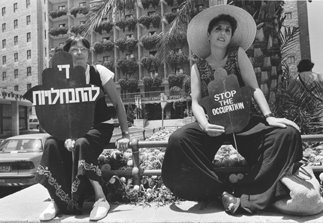
Women in Black, copyright Alan Pogue 2001

These members of Bat Shalom, an Israeli women's peace organization
nominated for the 2001 Nobel Prize for Peace, maintain a Women in Black
vigil in West Jerusalem. There are peace movements in Israel and in Palestine.
The Rapprochement Center does nonviolent resistance training.
There are Israeli soldiers who have gone to prison rather than se
rve
in the occupied territories. There is a Israeli group called Yesh Gvul
composed of active military, retired military and conscientious objectors

who maintain there can be no peace until the occupation of Palestine is over.
(Alan Pogue)


Press Your Face Against the Sky

I
climb out of the creek and press my face against the sky,
stretch out on limestone warmer than the air. Light
drops points of heat into my pores.
Small drops of water linger
just a moment.

On sunny days it’s warmer next to the creek than uphill,
in traffic, where the wind blows, where a human

appetite for power pushes us
to war after war.

On cold days I spread papers in the sun room where light
pours through long panes of glass until my work
space is static with dry heat. Cats wait
for me on a table splashed
with light.

I need juice —

for my computers, heat, air conditioning, don’t care
to wash my clothes along the river’s edge.
I like to plug things into power jacks.
Energy isn’t bad. I like cars too.
Today I stood with the Women in Black in front of the Capitol.
There was a slight chill in the breeze, but sunlight quickly
soaked through my dark clothing,

warming arms and back,
turning my long hair into a blanket.


We stood in front of the capitol because we want the world
to turn away from war. We want America to think
differently, act differently. We want
the occupation of Palestine
to end.

My father and grandfather were oil men whose business was
to make energy available to a society ravenous for it.
And we’ve grown hungrier still, so hungry that
two civilizations careen to war.


911 has pushed the world to a recession.
Business responds with massive layoffs and we spin further
down into depression —

We need a million jobs —

about what it would take to change world gears from carbon to light.
Invention waits for the right moment.

Press your face against the sky.

©Susan Bright, 2001


Shabbat

First a prayer, then bread, a sip of wine, cold gazpacho
with croutons made from homemade bread soaked in butter,
herbs. Virginia passes a platter of dates so delicious
I say I should have taken twelve instead of one

so she brings back the tray, and everyone takes more,
then squash casserole, baked chicken in mushroom sauce,
hummus and flat bread, olives and more olives,
another prayer, because this is a Shabbat, a song,
a dance, a community circle. The Jewish women
have arranged supper for women travelling to Palestine.

We practice speaking Arabic. Carole will bring back poems.
Everyone names a gift for the delegation. We send love
and hope, endurance, patience for listening, open minds,
courage, invention. We give donations to defray the cost.

Patrice, who has sold her car to raise money for the trip,
is at another fund-raiser. Joni talks about how she resisted
the trip at first, how it became a deep necessity.

I ask Lourdes, whose music is legend, if she will sing
or perform in Palestine. She says perhaps not
because mourning is not a time in Palestine for song.
I ask Annette what she fears the most. Her answer
reaches deep into the fabric of our world. She says,

If we are killed or harmed (even if by accident)
by the people living under occupation, it could
be used out of context to justify more atrocity.
She says,
A greater fear is that the ethnic cleansing
of Palestinians will not be stopped, that the entire region

will be destroyed. That is more important
than
one person’s life.
Friends bring huge plates
of baklava, which no one can resist, and marzipan.
I ask Annette what she is most confident about.

She says, The understanding that occurs when women
speak to one another, from that peace can be born, I trust it.
I say,
We will not allow the work to be corrupted,
and long for a global community supper,
plenty for everyone, no nationalites, just human beings
living in harmony. Virginia mingles in the crowd
carrying an oval basket of gigantic red grapes, succulent
and abundant, like
the vision of peace women

offer to the world with their lives.

©Susan Bright, 2001

Susan Bright is the author of nineteen books of poetry. She is the editor of Plain View Press which since 1975 has published one-hundred-and-fifty books. Her work as a poet, publisher, activist and educator has taken her all over the United States and abroad. Her most recent book, The Layers of Our Seeing, is a collection of poetry, photographs and essays about peace done in collaboration with photographer Alan Pogue and Middle Eastern journalist, Muna Hamzeh.

*Poems and photographs from The Layers of Our Seeing by Susan Bright, Muna Hamzeh and Alan Pogue. Plain View Press, 2001. Presently in it's 4 edition, this collection grows as the world it mirrors changes. Each print run is different.

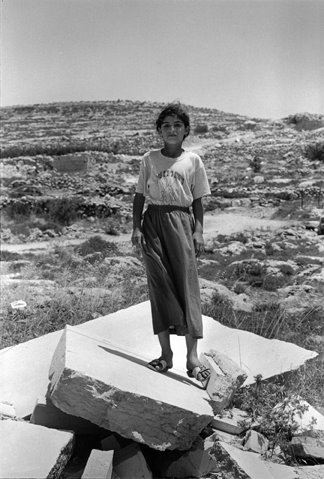
Phoenix Jabber, Alan Pogue, 1998, Hebron

Atta Jabber's oldest child stands on the ruins of a Jabber home. It has become one of the more than three thousand Palestinian homes which have been destroyed by the Israeli military occupation forces. No Palestinian can build or make a home improvement without the permission of the Israeli military courts. They are not likely to give permission. Even a passive rain water collector is not allowed. Digging a well is not even considered since the Israelis control water use in Palestinian territory. Palestinian families grow but their homes may not be expanded.

The Israeli government hopes to quietly force thousands of Palestinians off their land this way under the cover of a facade of legality. This leads to frustration and hopelessness among the Palestinians. Air and water are squeezed out of them. Even so Atta's daughter wears a "Peace Camp 95" tee shirt she received while attending a camp for Israeli and Palestinian children whose parents wished to foster mutual understanding and epaveful relations. Voices for peace must be fostered rather than ignored, as they are in the U. S. media. (Alan Pogue)

HOME

What it is About

Earthfamily Principles

Earthfamilyalpha Content II

Earthfamilyalpha Content

Links

LANGUAGE TRANSLATIONS

Tuesday, February 28, 2012

John Collins Andrews


John Collins Andrews (1948-2012)

J
ust 12 days ago, around three o'clock, I was talking with Sarah in my office at the Utility when my cell phone vibrated. It was Ted. "I have bad news", he said. "How bad?" I asked. "JC has stage 4 lung cancer."

Within a few hours, I was sitting next to him on his bed in the hospital. He had thought he might have pneumonia when his son dropped him off at the south Austin hospital just two days before.

Jay turned to me. "Wow, this dying shit is really weird", he says.

There with Jimmy, his long time pal from childhood, Sherry, who looked like his long lost sister, and Dana, the Angel Doctor, we chatted with the oncologist. We chatted about palliative care, about future testing, about money, about wills, power of attorney, about S.S.I, about M.A.P., about who would do what and when.

The oncologist was particularly polite but blunt. "Texas is one of the worst states for someone in your situation, " he said. "You will need a champion...someone who will break through the system...someone who will stubbornly work in your behalf." He said he would give us some time and order some more imaging to see if the cancer was in the brain and in the bone.

It was.

Over the next few days, JC's room was busy. Mick brought him Torchy tacos, which Jay ate. His Plainview friend Dee brought soup. Ted, his neighbor, co-worker, former lawyer, and friend hovers like a helicopter parent. Gazork, another boyhood friend flys in from Boise. His son Daryl comes in and out, doing his best to cope with the situation.

Because you see, John Collins Andrews and Susan Bright, the poet/activist were a couple. And just 13 months ago, we had Susan's service at Barton Springs Pool after her short bout with cancer.

By Thursday, plans were finalized. Jimmy and Gazork would drive Jay to a hospice in his boyhood home, Plainview. There he could see his aging mother Dorothy, and meet up with the rest of the family on Friday. The drive took all day, but JC sat up as they drove up the caprock onto the high plains.

On Saturday, Liz, Jay's doctor sister from San Francisco arrives to join their brother James. They all visit as Jay grows weak. I never heard him complain or saw him weep.

At midnight, our brother crossed over.

Liz's obituary captures him pretty well.

John Collins Andrews. Beloved son and brother, cherished father, boundless friend, John Andrews died in Plainview, Texas on February 25th, 2012 after a brief illness. John, known as J.C. to his family and close friends, was such a colorful person. He lived on his own terms in many ways, forever questioning the status quo but also taking time to appreciate all that was around him. In equal measure he could passionately discuss the politics of wind and water or convey an infectious wonderment in the geologic formation of the Llano Estacado.

John was active in the
evolution of capturing the wind power of the Panhandle and an advocate of the Save Our Springs (SOS) Initiative in Austin.

John was born April 26, 1948 in Lubbock, Texas. He liked to say that
Buddy Holly lived on his block. He loved his West Texas roots and returned often. He graduated from the University of St.Thomas in Houston with a degree in history. There he was introduced to the art scene of the DeMenil’s and to the era of independent film production. John was an early guerrilla documentary film maker when the art was first developing and he had a special talent for editing that was well respected and recognised in the film community.

After graduation and
travels, John settled in Austin where he and wife Susan Bright later established the venerable Plain View Press and began publishing poetry, essays and other literature. This literary venture spanned over 25 years.

John discovered his love of street vending when he and a friend
created the very first “rolling armadillo” toy and began selling on the drag at the 24th Street Market sometime around 1971. This evolved into, and thus began, the tradition of having a booth with his family at the Armadillo Christmas Bazaar every year and providing a lively place for friends and visitors to stop by and chat, purchase literature, jewelry and trinkets, and enjoy stimulating conversations. Truth be told, John was known for giving away almost as much as he sold mostly because John loved the conversations as much as the sale.

John was a true renaissance man, equally at ease at art openings and
political meetings as he was working on carpentry projects in his garage or in a bass boat on the lake. John was a friend to, and involved with, so many different groups of people in Austin it would be impossible to name them all without leaving some out. Moreover, his dedication, loyalty and love for his friends, and especially his family and his son, Daryl, is one of his most endearing and memorable traits.

John was preceded in death by his father, John P. Andrews, and his
wife, Susan Bright. He is survived by his mother, Dorothy Andrews and brother, James Andrews both of Plainview, sister Liz Andrews of San Francisco, CA, son, Daryl Bright Andrews and grandson, Tristen Cinelli of Austin.

A celebration with family of John’s life is planned for
this summer in West Texas somewhere near the Caprock where the wind blows. In lieu of flowers, the family requests donation to Physicians for a National Health Program (PNHP.org), a healthcare reform advocacy group.


I first met JC when he and Jimmy came out to Space City Video at the mansion in Taylor to edit some videotape. At the time, they were doing vanity horse jumping videos. That was 38 years ago. Soon, they were making more meatier films. One, was the Grok Book poetry readings. I watched Jay fall in love with Susan as he edited her fire and form. They were married not too long after.

JC, as much as anyone in my life made ideas manifest. He made the video documentary of my Pampa Wind Farm in 1981. He helped me build my first passive solar houses. He was the contractor when Eddie and Phil and I completely rebuilt Sholz Garden in 1987. He helped me manage my West Campus properties during the real estate black death of 1988.

In the nineties, we went west and put up the first met towers to pave the way for the wind industry 10 years later. He shot (and lost) my first attempt to create a light bending solar laser in the bowels of the UT Austin physics lab. He helped me build my Frank Lloyd Wrong home in Elgin and countless other projects.

He even cut all of the little tiny pieces that we used to build Argonon, so I could build that giant model City of the Future.

In the last 10 years, I was busy at the Utility and he was busy with Plainview Press. He also truly found his calling working on the street, tying those beautiful knots to carry those gods and deities from his trinket wheel.

When Susan passed, he asked me to direct the service.

JC was as important to me (and so many others)

as track is to a train.

And he is right....

"This dying shit is weird."

Over the last few years,

we would always say goodby by saying

"love you Brother."

love you Brother...

safe crossing


Note: There is a JCA Memorial Altar forming at 1509 Dexter. Please bring flowers and mementos....a central texas service has not been planned yet.

Important...There is a memorial for JC Tuesday, March 6th at 5:30 at Marias Taco Express, 2529 South Lamar


Labels: , ,

Wednesday, June 10, 2009

Adopt A Tree


*
L
egend


There was a desert.

For a vast distance
nothing grew until, quite suddenly,
a great and very large bird
appeared.

The bird spat out a seed
which fell to sand, aching for life.

As it sunk below the surface
where we cannot see what happens,
a cry echoed from sand
to stone, from crevasse to karst,
from cave to fossil, a vibrant cry
of thirst resounded, underground,
where we can’t see what happens.

The cry criss-crossed its own
thirsty rhythm, intersected itself,
grew stronger, more urgent,
more perfectly beautiful —
a dark, brilliant necessity.

The seed stretched and broke,
sang and again sang, and again
sang it’s cry of thirst —

until deep below the surface
a flowing, jubilant,
cool, emerald answer
emerged.

It is said the thirst of Earth’s
great trees calls water
from depths which are invisible
causing springs to flow.

©Susan Bright, 2009

Susan Bright is the author of nineteen books of poetry. She is the editor of Plain View Press which since 1975 has published two-hundred-and-fifty books. Her work as a poet, publisher, activist and educator has taken her all over the United States and abroad. Her most recent book, The Layers of Our Seeing, is a collection of poetry, photographs and essays about peace done in collaboration with photographer Alan Pogue and Middle Eastern journalist, Muna Hamzeh

* Photo by Alan Pogue.

follow me on TwitterAnnouncements:

For up to date information about how you can help Save the Heritage Trees at Barton Springs:
BartonSpringsPublicProcess.com -- please take a minute to send the letters posted there, and/or one/s of your own.

Aielli Unleashed: Listen to Bill Oliver, Danny Britt, Beth Gallager, Marvin Dykhuis sing and play tree and river songs. Susan Bright reads the poem above. Bill Bunch talks about our Heritage Trees at Barton Springs.

Press Conference: Announcing an Adopt-a-Tree program for the heritage trees at Barton Springs. Thursday, 11am to noon, entrance to Barton Springs pool.


SB calling for the tree behind her to be named
the Poets' Tree --
pledging and
calling for pledges of other poets to adopt
this beautiful old tree in the name
of poetry.
To pledge email: sbpvp@sbcglobal.net


Action: Send a letter asking Council to strengthen, not dilute, City Code to protect Heritage trees. There will be a council briefing June 11, 2-3 pm, City Council Chambers. Bring Signs.
Meetings are broadcast on municipal TV cable channel 6 and on 88.7 FM radio, starting at 1:30 p.m.

Barton Springs Heart And Soul -- New video by Brian Leonard


HOME
.
Earthfamily Principles
.
Earthfamilyalpha Content IV
Earthfamilyalpha Content III
Earthfamilyalpha Content II
Earthfamilyalpha Content
.
Links
.
LANGUAGE TRANSLATIONS

Labels: ,

Thursday, September 13, 2007

Being A Nut


*

Being a Nut

I wasn’t going to talk to anyone
until after I got out of the water
but one of the regular swimmers engaged me
as I was stuffing wax into my ears,
“I read your comments on the elist
about the pool plan and they were
enlightened, good,” she said and
then went on. “One of my co-workers
asked me if I knew Susan Bright, said
you were a nut.”

“Tell her to read my resume,” I snapped
before I had time to recall my resolve.

About half way down to the dam,
my hand cupped a new pecan, just breaking
out of it’s green outer shell.

It was floating
in the emerald water.

These limestone creek beds with lush sloping
banks which have gifted Central
Texas
with water for ages, are called Pecan Bottoms.

The stately, old, gnarled trees send tap roots
into water below the level of what we see, where half
the life of a tree occurs.

Above and below ground
pecan trees are integral
to the habitat that spawns
our springs, filters rainwater

as it percolates through porous limestone
and flows into our creeks.

If you peel back one of these early, floating pecans
and inhale the aroma, you can smell the essence
of green—

wood resin, dirt, fresh spring water — green.


If you take it home, smell it again, the green
vanishes.

It exists, fragile and instantaneous,

here, in the water, right after the nut breaks loose from
an overhanging branch.

I wrote something on the elist recently
about a city proposal to cut down pecan trees, replace
them with other species, less likely to drop branches.

One of the children, a six-year-old,
heard us talking

about the pool master plan, said,
“If you stand under a tree in a storm,
it’s your own fault if you get hit.”

Later, she added, “You could hear
it cracking, and the lower branches would
slow it down, so you would have time to move.”

We tried to remember if anyone had ever been
hurt by a tree in Zilker Park.

Mark Twain wrote about a safe that fell
off scaffolding and killed a man who had been
standing below, next to a dog. He said the man
“were appointed by the lord” to be killed by
the falling safe. He said, “You might wonder why
the dog weren’t appointed.”

His answer was, simply, “The dog would have
seen it coming.”

I don’t want the city to cut down pecan trees
alongside our pool, or in Zilker Park, or anyplace.

I am against cutting down trees.

My grandmother, who lived in Pennsylvania,
in some of America’s most verdant woodlands,
built her summer living quarters around the trees
that grew alongside her creek so you had
to step outside and walk across a series of small
ledges built around the trees
to get from room to room.

By the time I got out of the water
I realized being a nut was a good thing.

In a global culture devoid of common sense,
this instinct for green could be
our saving grace.

©Susan Bright, 2007

Susan Bright is the author of nineteen books of poetry. She is the editor of Plain View Press which since 1975 has published one-hundred-and-ninety books. Her work as a poet, publisher, activist and educator has taken her all over the United States and abroad. Her most recent book, The Layers of Our Seeing, is a collection of poetry, photographs and essays about peace done in collaboration with photographer Alan Pogue and Middle Eastern journalist, Muna Hamzeh.


*Photo from website of Sherry Williams.


HOME

What it is About
Earthfamily Principles

Earthfamilyalpha Content III
Earthfamilyalpha Content II
Earthfamilyalpha Content

Links

LANGUAGE TRANSLATIONS

Labels: ,

Saturday, April 14, 2007

Lecto divina


**
Illumination

In the first place it was holy, the word. Note the remarkable picture of Mary with the Baby Jesus cradled in an enormous book,* which doesn’t prove she could read or that the child could. He appears to be asleep, strapped in, halo intact. It proved that the Bible was the word of God. Illumination was for enchantment—letters, words or passages were painted in gold leaf, or blue from lapis lazuli and indigo, red from iron or the pregnant body of a Mediterranean insect, copper for green. Illuminated words were windows through which holy spirits and angels singing could traverse the vast distance between holiness and us. On something like a ray of sunlight in the early morning, (starlight after dark), magical beings could slide into the meditation room where monks or nuns prayed or sang from antiphonals (song books) taller than the younger members of the sect, large print so everyone could sing the same notes at the same time. Gold words were linked to God, Green to Saint Catherine, Red to Jesus, Blue to the Virgin Mary—like the internet— click, and from afar would come information, inspiration, salvation, healing, passion, ecstasy, holiness. Lecto divina, worship of the word. Mystics sat with saints and angels. Jesus and Mary whispered into the ears of scribes who painted slowly, carefully. Occasionally elves slipped into morning devotions, or found their way through the quills and brushes in the scriptorium to decorate letters, to fill border space. They were drollarys—funny green people wearing squash caps, sucking wine and reading little books of their own, books inside of books. Quickly these little people were spirited away to secular work which grew up around the church the way villages created cathedrals and then surrounded them with cities. Words wanted decoration in the Middle Ages, and people wanted beautiful books they could hold in their hands, tie onto their belts, slip into satchels thrown across the back of a burro, take on crusades. Scribes copied books and illuminators illustrated them, parchmenters made paper out of the skins of cows or sheep. That stouffe that we wrytte upon: and is made of beestis skynnes; is somtyme called parchment somtyme velem. A careful scribe could select the animal in person, an animal to be skinned, a quite visceral holiness.

*Rohan Hours, 1331

** Kiss of Judas, Folio from Evangelariumca., 1500Illumination on vellum, Boston Public Library, Josiah H. Benton Fund, Ms. pb. Med. 18

* From Next to the Last Word, Susan Bright, 1998, Plain View Press.

In Honor of National Poetry Month and the Austin International Poetry Festival April 12-15. Plain View Press is hosting the book exhibit for AIPF this year and the studio will be open for browsing 10 AM to dark. In you're in Austin, email sb@plainviewpress.net for directions.

© Susan Bright, 1998.

Susan Bright is the author of nineteen books of poetry. She is the editor of Plain View Press which since 1975 has published one-hundred-and-fifty books. Her work as a poet, publisher, activist and educator has taken her all over the United States and abroad. Her most recent book, The Layers of Our Seeing, is a collection of poetry, photographs and essays about peace done in collaboration with photographer Alan Pogue and Middle Eastern journalist, Muna Hamzeh.

Announcement: The Plain View Press e-store has just gone online.

HOME

What it is About
Earthfamily Principles
Earthfamilyalpha Content III
Earthfamilyalpha Content II
Earthfamilyalpha Content

Links

LANGUAGE TRANSLATIONS

Labels:

Saturday, November 25, 2006

Family


Cause for Celebration
for Liz, Katrina and **Elijah

Consider, for example, a day full
of fog and confusion, world politics —

Consider, on such a day, the possibility
that love could grow anyplace
on the planet, on Tuesday, in your
life, for instance and quickly
breathe the miracle of it —
her million faces,
how she is loyal past all
logic, how she has endured
the odd collapse of meaning
that is our time on earth —

Consider —
that a woman
raised on a dryland farm in Texas
and a man whose family
fled Eastern Europe
have raised a girl who is
a physician in one of
the finest cities on earth,
a girl who today marries
another girl,
who teaches school
whose family knows
a different journey—
how love is greater than
the distances between us,
and vastly better.

Consider, on your darkest day,
the distances we have all
traveled —
how love, in spite of everything
anyone can to do to confuse it,
brings us to focus
and is in her
exuberant
or quiet self
cause
for celebration,
for prayer,
for ceremony,
for celebration.

* Photos by Susan Bright.
** The prophet Elijah was a creator and receiver of miracles.


©Susan Bright, 2001

Susan Bright is the author of nineteen books of poetry. She is the editor of Plain View Press which since 1975 has published one-hundred-and-fifty books. Her work as a poet, publisher, activist and educator has taken her all over the United States and abroad. Her most recent book, The Layers of Our Seeing, is a collection of poetry, photographs and essays about peace done in collaboration with photographer Alan Pogue and Middle Eastern journalist, Muna Hamzeh.

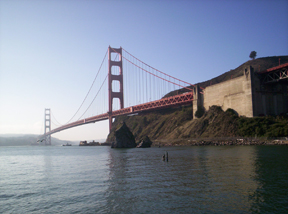
The photo of the Golden Gate Bridge was taken from a pier at Fort Baker on the Northeast edge of the bridge, alongside the Bay Area Discovery Museum, a magical place for children and their parents.

HOME

What it is About

Earthfamily Principles

Earthfamilyalpha Content II

Earthfamilyalpha Content

Links

LANGUAGE TRANSLATIONS